Repurposing 101
You spent real time creating that piece of content. You researched, you drafted, you revised, you published. And then — like most authors — you moved on to the next thing.
Here is the question worth sitting with: what if publishing was never meant to be the finish line?
One of the most consistent missed opportunities I see with the authors I work with is treating content as a one-and-done exercise. You write the blog post, you share it once, and then it disappears into the archive while you start the whole creation cycle over again. That approach is exhausting, and it leaves enormous marketing value on the table.
The alternative is content repurposing — and it is not just a time-saving tactic. It is a genuine growth strategy. When you build a system around each piece of content you create, that content keeps working for you long after you have moved on to what comes next. One idea, one class, one interview, one blog post becomes the source for weeks or even months of strategic marketing activity across every platform your readers use.
This post walks through exactly how that works — and how you can start building a content repurposing system of your own, starting with whatever you have already created.
Publishing is just the beginning — just like your book. The real marketing work starts after you hit publish.
Why Repurposing Is a Growth Strategy, Not Just a Time Saver
Let's address the most common misconception first: content repurposing is not about being lazy or recycling mediocre content. It is about getting strategic results from the work you are already doing.
When you create a strong piece of long-form content — a blog post, a podcast episode, a class, a live video — you are doing the hardest part of content marketing. You are developing an idea fully, grounding it in your expertise, and structuring it in a way that delivers real value. Repurposing takes that investment and multiplies its return.
Here is what a deliberate repurposing strategy actually does for your author business:
It saves time and budget without sacrificing quality
When you are creating original content from scratch every day, you are constantly depleting your creative and logistical resources. Repurposing shifts the equation. Your long-form content becomes the source material from which shorter assets are derived — social posts, email excerpts, quote graphics, short-form video clips — so you are not starting from zero every time you need to show up somewhere.
It reaches readers where they actually are
Your audience is not all in one place, and they do not all consume content the same way. Some readers prefer email. Others scroll social media. Others listen to podcasts on their commute or watch short videos during lunch. Repurposing ensures that the same core idea reaches readers in the format they are most likely to engage with — increasing the number of touchpoints between your brand and your potential readers significantly.
It strengthens both SEO and GEO
Traditional search engine optimization benefits from keyword reinforcement, internal linking, and backlinks — all of which are natural byproducts of repurposing the same content across multiple platforms and formats. But repurposing also supports something newer and increasingly important: Generative Engine Optimization, or GEO.
GEO is the practice of creating content in ways that help AI tools — like the large language models powering search features in Google, Bing, and ChatGPT — find, understand, and surface your work accurately when someone asks a relevant question. When your ideas appear across multiple well-structured formats and platforms, AI systems are more likely to recognize your authority on a topic and reference your content in their responses. For authors building long-term discoverability, this is a meaningful and emerging advantage.
It reinforces your authority and builds trust
Familiarity is the foundation of trust, and trust is the foundation of book sales. When potential readers encounter your ideas across multiple platforms and in multiple formats — a blog post, a podcast mention, a social quote, an email newsletter — they begin to recognize you as a consistent, credible presence in your space. You are not just posting. You are showing up, again and again, as someone worth paying attention to.
It increases conversions over time
Repetition builds recognition, and recognition builds action. Research on marketing consistently shows that people need multiple exposures to a message before they take action — whether that action is clicking a link, signing up for an email list, or buying a book. Repurposing creates those additional exposures naturally, across different contexts and platforms, without requiring you to create new arguments or new content from scratch each time.
Stop asking 'What should I post today?' and start asking 'How can this one piece of content work harder for me?' That single shift changes everything.
Repurposing in Action: How One Idea Becomes a Content Ecosystem
The best way to understand content repurposing is to see it in practice. Here is a real example of how my own content — including this very post — moved through a complete repurposing cycle.
It started with a single live teaching event: a class inside the Authors' Allies Roundtable membership on how to create a discoverable author website in 2026. That one class became the seed of an entire content ecosystem.
Phase One: Creation and Primary Distribution
The creation phase established the core asset — the original long-form content from which everything else would flow.
The class was taught live inside the Authors' Allies membership community
Supporting slides were created using Google NotebookLM — many of which can also serve as standalone graphics for social media
The class transcript was organized using Claude into a structured blog draft
The draft was refined and published on Substack as a full blog post
Substack automatically emailed the post to all subscribers — so publishing and email distribution happened simultaneously
Note: This is the creation-to-primary-distribution arc. One teaching session became a slide deck, a blog post, and an email newsletter — with minimal additional creation effort beyond the original class.
Phase Two: Distribution and Amplification
Once the primary asset was live, the focus shifted to distributing it across platforms — reaching readers who would not have seen it in its original form.
Substack's built-in share assets feature was used to generate quick visuals and short video snippets from the post
Story content was posted on Meta to announce the article and drive traffic back to Substack
A main social post was scheduled across platforms using HighLevel, with a future repost already built in so the content would resurface automatically weeks later
Short-form videos were scheduled across TikTok, YouTube Shorts, and Instagram Reels
At this point, one live class had become: a slide deck, a blog post, an email newsletter, a story post, a main feed social post with a scheduled repost, and multiple short-form videos. And it was still not finished.
Phase Three: Extending the Content Lifecycle
This is where most authors stop — but it is also where some of the most valuable repurposing opportunities begin. While reviewing the blog post, I recognized that both the website content and the repurposing content itself could become separate podcast episodes. Below is part 1 of building your repurposing strategy. Not only did I turn this information into a podcast but I did it, Ep #46, live (this was my first ever live podcast episode) so that I could double-dip on the algorithm.
A podcast episode opens a new layer of derivative assets:
Audiograms — short branded audio clips with waveform visuals for social media
Quote graphics pulled from the episode's most shareable moments
Email content summarizing the episode and linking back to both the podcast and the original blog
Additional blog embeds pulling the episode into the original post and vice versa, strengthening internal links
Each new asset also creates opportunities to link back to the original content — the blog, the Substack post, the membership class — building a web of interconnected content that reinforces the core ideas from multiple angles.
The Result: What started as a single teaching session became a blog, an email, a social campaign, multiple videos, a podcast episode, audiograms, quote graphics, and more — all pointing back to each other and to my core author community and resources.
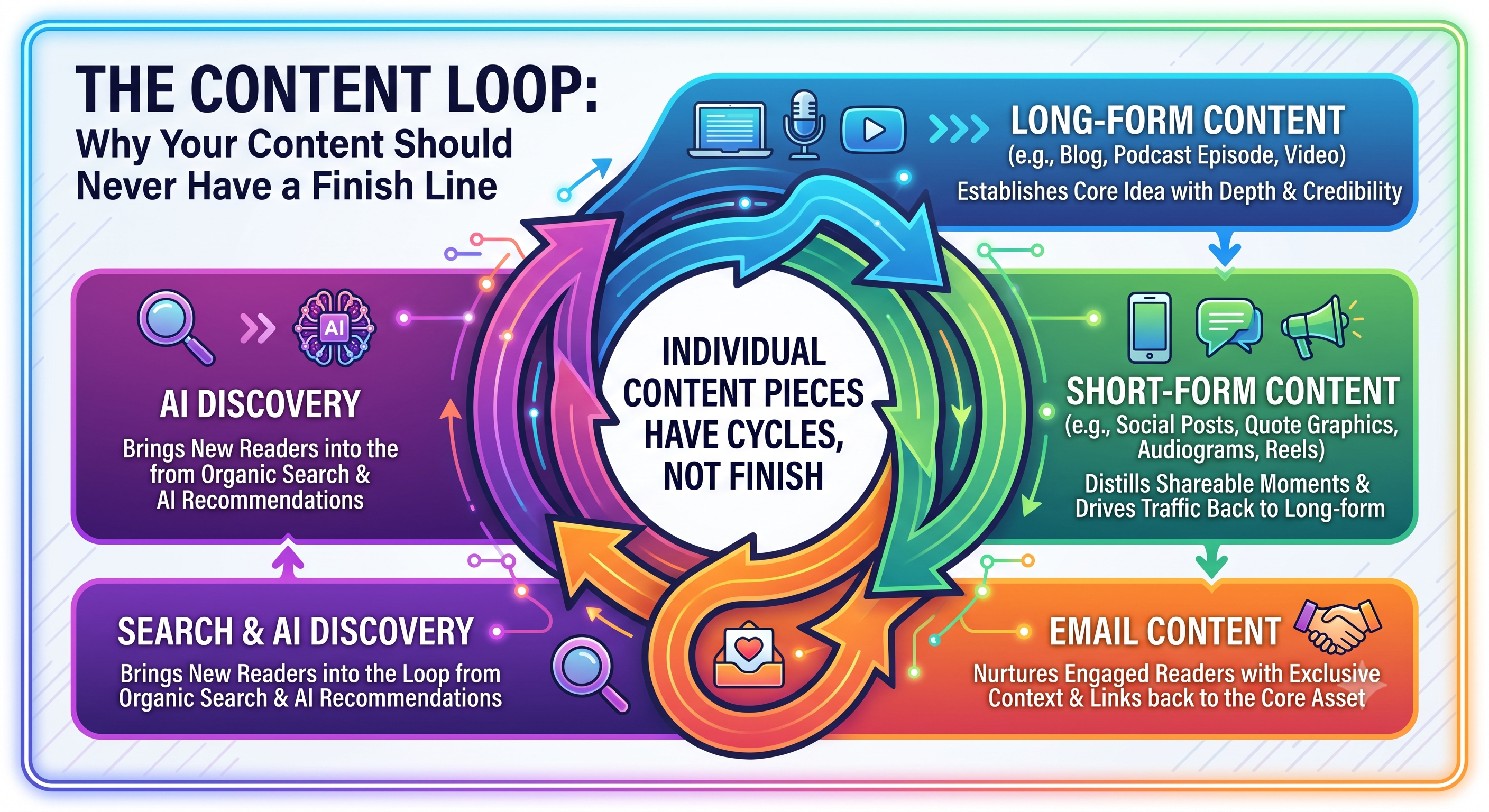
The Content Loop: Why Your Content Should Never Have a Finish Line
Here is the key insight that changes how you think about content creation: individual pieces of content do not have finish lines. They have cycles.
When content is created and distributed in a connected, intentional way, each format feeds the others. A blog post drives podcast listeners. A podcast episode drives email subscribers. An email drives social followers back to the blog. A social post drives new readers to the podcast. And the cycle continues, with each platform pointing readers toward your core assets and toward you.
This is what a content loop looks like in practice:
Long-form content (blog, podcast episode, video) establishes the core idea with depth and credibility
Short-form content (social posts, quote graphics, audiograms, Reels) distills the most shareable moments and drives traffic back to the long-form piece
Email content nurtures your most engaged readers with exclusive context, links to the core asset, and a direct relationship
Search and AI discovery (SEO and GEO) brings new readers into the loop from organic search and AI-generated recommendations
None of these formats exist in isolation. Each one is an entry point into your content ecosystem — and a pathway back to your books, your email list, and your author community.
The Big Shift: From Content Creation to Content Systems
The difference between authors who feel constantly behind on content and authors who feel like their marketing is working for them comes down to one thing: systems thinking.
Most authors approach content with a single question: what should I post today? That question leads to reactive, exhausting content creation that starts from zero every single time.
The more powerful question is: how can this one piece of content work harder for me?
When you start thinking in systems rather than individual posts, content creation becomes dramatically more sustainable. You are not chasing ideas — you are working a process. You create once with intention, distribute across multiple formats and platforms, and then let the system keep working while you focus on writing.
What a basic content repurposing system looks like
You do not need a large team or sophisticated tools to build a repurposing system. A simple, repeatable workflow is enough to start:
Create one piece of substantial long-form content — a blog post, a class, an interview, a detailed social thread — that fully develops an idea valuable to your ideal reader
Identify the three to five most shareable moments, insights, or quotes within that content
Adapt those moments into platform-appropriate short-form assets — graphics, short video clips, email excerpts, story posts
Schedule distribution across your active platforms, staggered over days or weeks so the same idea appears in different formats at different times
Build in a repost or re-share at thirty to sixty days so the content resurfaces for readers who missed it the first time
Connect each asset back to the original long-form piece with a clear link or call to action
That is the full cycle. And once you have run through it a few times, it becomes second nature — a content habit that multiplies the value of everything you create.
Tools that support a repurposing workflow
Several tools make the repurposing process more efficient, particularly for authors who are managing content across multiple platforms without a large support team:
Google NotebookLM — for organizing and synthesizing source material, generating slide content, and structuring long-form drafts
Claude — for organizing transcripts, drafting structured blog posts from raw content, and refining copy
Substack — for primary blog publishing with built-in email distribution and share asset generation
Hootsuite, Meta, Metricool, HighLevel, etc. — for scheduling and automating social distribution across platforms, including future reposts
High Level, BookFunnel or ConvertKit — for email list management and reader magnet delivery (High Level, I use Simple Business Suite, is an all-in-one business management platform.)
You do not need all of these tools to start. A simple blog platform, a basic email service, and one social scheduling tool are enough to build your first repurposing system.
Action Step: Take one piece of content you have already published — a blog post, a podcast episode, a newsletter — and map out five assets you could create from it. A quote graphic. A short video. An email excerpt. A social post. A story announcement. You already have the raw material. The repurposing is just the next step.
🎙 Content strategy and repurposing are recurring themes on the Authors' Allies Podcast. For more on building a marketing system that supports your writing life, listen at www.bluedotdigitalmarketing.com/podcast or find us on YouTube at youtube.com/@rebeccapaciorekAuthorsAllies
Ready to Build a Content System That Works for You?
The Authors' Allies Roundtable is where authors learn to build content and marketing systems like the one described in this post — step by step, inside a supportive community of fellow female authors, with expert guidance from me at every stage.
Inside the Roundtable, you will find:
Live classes on content strategy, author branding, book marketing, and platform growth
A community of authors who are actively building their platforms alongside their writing
Resources, templates, and workflows you can implement immediately
Monthly strategy sessions to keep your marketing moving forward
Free Pass: Email [email protected] to request a free pass to check out the Authors' Allies Roundtable. We would love to have you.
Not ready for the Roundtable yet? Start with the free ebook — 10 Steps to Creating Your Ultimate Book Marketing Plan — at www.bluedotdigitalmarketing.com/10step-ebook.
Frequently Asked Questions About Content Repurposing for Authors
What does content repurposing actually mean for authors?
Content repurposing means taking one piece of original content — a blog post, a podcast episode, a live class, a newsletter, an interview — and adapting it into multiple formats for distribution across different platforms. Instead of creating a new idea for every post, every email, and every video, you develop one idea thoroughly and then extract smaller assets from it. A blog post becomes social graphics, email content, short-form video clips, and audiograms. A podcast episode becomes a blog, a newsletter, and a series of quote posts. The core idea does the heavy lifting; the formats change to meet readers where they are.
How is repurposing different from just reposting the same content?
Reposting means sharing the same piece of content again without changes. Repurposing means adapting the core idea into a new format suited to a different platform or audience segment. A quote pulled from a blog post and turned into a branded graphic is not a repost — it is a new asset derived from the same source material. Repurposing respects the fact that different readers consume content differently and exist in different places, and it meets them where they are with a version of your idea they can actually use in their context.
What is GEO and why should authors care about it?
GEO stands for Generative Engine Optimization — the practice of creating content in ways that help AI tools find, understand, and surface your work when someone asks a relevant question. As AI-powered search features become standard across Google, Bing, and standalone tools like ChatGPT, the way people discover content is shifting. AI systems surface content from sources they recognize as credible, consistent, and well-structured. When your ideas appear across multiple platforms in multiple well-organized formats, AI tools are more likely to recognize your authority and reference your content in generated responses. For authors building long-term discoverability, this is increasingly important.
Do I need to be on every platform for repurposing to work?
No — and trying to be everywhere at once is one of the fastest paths to content burnout. Effective repurposing means being present on the platforms where your ideal reader actually spends time, and distributing your content there consistently. For most authors, that means a blog or newsletter as the primary long-form home, one or two social platforms where your reader engages, and an email list. You can expand as your capacity grows, but starting with a focused set of platforms and repurposing consistently across them will outperform scattered presence on a dozen channels.
How do I know which content is worth repurposing?
Any content that performed well — in terms of engagement, shares, replies, or conversions — is a strong candidate for repurposing. So is evergreen content: posts about foundational topics that remain relevant regardless of when a reader finds them. For authors, this often includes content about your writing process, your book's themes, your author journey, or practical advice in your area of expertise. If a post resonated the first time, chances are there is an audience on another platform who would value the same idea in a different format.
How long should I wait before repurposing a piece of content?
You do not need to wait at all — in fact, the most effective approach is to plan your repurposing assets at the same time you plan the original content, and begin distributing them immediately after the primary piece goes live. The distribution window for a blog post or podcast episode is typically strongest in the first one to two weeks after publication, which is precisely when you want supporting assets amplifying it across platforms. After that initial window, you can schedule reposts and recycled assets at thirty to sixty days to resurface the content for readers who missed the first wave.
Can I repurpose content I created years ago?
Absolutely — particularly if it is evergreen. Older content that covers foundational topics, tells a personal story, or addresses a question your ideal reader consistently asks is fair game for repurposing at any time. Before repurposing older content, do a quick review to make sure the information is still accurate and the framing reflects your current brand voice. If it needs updating, update it. If it holds up well, adapt it into new formats with confidence. Your back catalog of content is an underutilized asset that can fuel new marketing activity without any additional creation from scratch.
What is the minimum viable repurposing workflow for a busy author?
If you are short on time, start with this: every time you publish a blog post or newsletter, create two additional assets from it before you move on. A quote graphic from the most shareable line. A short social post summarizing the core idea with a link back to the full piece. That alone doubles the distribution reach of every piece of content you create. As you build capacity and comfort with the process, add a third and fourth asset. The goal is not to do everything at once — it is to build a sustainable habit that compounds over time.